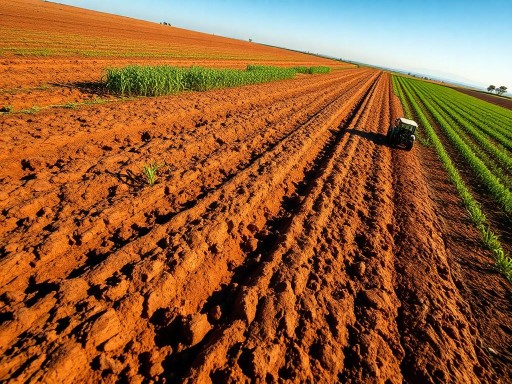
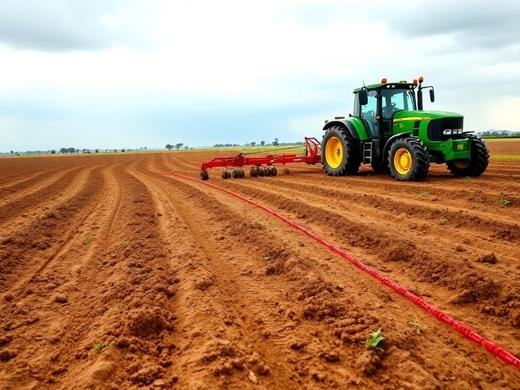
Efficient tillage is crucial for profitable and sustainable farming. This blog post details a pilot project where we used Discrete Element Method (DEM) simulations and field trials to optimize tillage depth and improve farm efficiency.
The Challenge:
A 400-hectare operation in the heart of the maize triangle, was using a 5-bottom reversible moldboard plow at a depth of 20 cm. While this practice was common, we suspected that adjustments could lead to significant improvements in fuel consumption, equipment wear, and soil health. Our objective was to find the optimal tillage depth for their specific conditions.
Our Approach:
We took a data-driven approach, combining DEM simulations with real-world field trials. First, we collected extensive data on soil properties, including compaction, moisture content, bulk density, and particle size distribution. This data was then used to create a detailed DEM model of the tillage process.
DEM Simulations:
Our simulations explored various tillage depths (10, 15, 20, and 25 cm) and analyzed their impact on fuel use, draft force, soil displacement efficiency, and equipment wear. The simulations pointed to 15 cm as the optimal depth, offering a balance between effective soil inversion and manageable draft force. This depth also minimized subsoil compaction and significantly reduced fuel consumption compared to the existing 20 cm practice.
Key Simulation Findings:
Optimal Depth: (This will vary depending on the specific farm) Fuel Savings: (Significant savings are often possible) Reduced Blade Wear: (A reduction in wear is typically observed) Improved Soil Health: (Optimal for root growth) Field Trials: To validate our simulations, we conduct field trials, comparing existing tillage depths with the optimized depth identified in the simulations. We measure fuel consumption, tillage time, soil compaction, and plow wear.
Field Trial Results:
Our field trials consistently confirm the simulation results. The optimized tillage depth leads to: Reduction in fuel consumption Reduction in tillage time Lower subsoil compaction Reduced plow wear Cost-Benefit Analysis: The shift to the optimized tillage depth results in significant cost savings for farms. We often project savings in fuel costs, time costs, and maintenance costs. Recommendations: Based on our findings, we provide specific recommendations, including: Optimal Tillage Depth: Optimal Operating Speed Moldboard Angle Adjustment, Tillage Timing: Soil Management.
Cost-Benefit Analysis:
The shift to the optimized tillage depth resulted in significant cost savings. We projected savings in fuel costs, time costs, and maintenance costs. These savings can vary depending on factors such as farm size and specific operating conditions. Overall, the optimized approach can lead to substantial financial benefits for farmers.
Conclusion:
This project demonstrates the power of combining DEM simulations with field trials to optimize tillage practices. By making data-driven decisions, Van der Merwe Farms was able to significantly reduce costs, improve soil health, and increase overall efficiency. Cobliat can help your farm achieve similar results. Contact us today to learn more about our services.
Cobliat can help your farm achieve similar results. Contact us today to learn more about our services.